I read an article about a group of researchers who helped at risk high school students read and write graphic novels. The article: "Adolescents and 'Autobiographies': Reading and Writing Coming-of-Age Graphic Novels" by Hughes, King, Perkins, and Fuke. There was a lot I took away from it that may help me when I implement my afterschool program. Here are some cliff notes:
-The authors argue that kids are exposed to multimodal literacies everyday: "the dominant site of texts is now the screen, and that the screen is the site of the visual, such as the image". Graphic novels can simultaneously tap into, and help expand students' "multimodal literacy".
-Besides reading graphic novels, creating having students create their own graphic novels about integral moments in their lives was important because " 'When students are given opportunities to share their identity texts with peers, family, teachers, and the general public through media, they are likely to make gains in self-confidence, self-esteem, and a sense of community belonging through positive feedback.' (CUmmins, Brown, and Sayers, 2007)" My interpretation of this is that the process of writing graphic novels actually can reshape students' identities and self-images. What a novel idea!
-An interesting challenge with the reading of graphic novels is that since there's a lot of pictures to view and interpret, the pace of reading is quite varied, so stay away from read alouds. I think we should be ok with partner reading though.
-An interesting challenge with making graphic novels is that students often aren't confident or satisfied with their artistic abilities. This is why it'll be important to enlist some students with artistic skills and pair them up strategically with non-artistically gifted students. Also, you can teach students how to represent human characters abstractly or as animals/objects that are easier to draw. One girl did an awesome job with raindrops!
-Not surprisingly, the students were highly motivated to work on graphic novels because there was an element of playfulness. i hope for the same.
-One interesting nuance to how graphic novels develop students' ability to infer: "The nature of graphic novel format also forced students to make inferences across the gutters (i.e. the space between the panels) as they moved from one image to the next." Never considered this...
Wednesday, November 30, 2011

Tuesday, November 29, 2011
The Power of Graphic Novels

Deavion is addicted to the Lunch Lady series
Today when we were in the hallway:
Deavion: Mr. Welch are we doing independent reading?
Me: No, we have to finish a reading test.
Deavion looks disappointed.
Me: Do you want to do independent reading.
Deavion nods.
Me: Why do you like independent reading so much now?
Deavion: Because I get to read with other people.
Me: Why's that important to you?
Deavion: Because when I get stuck on a word there's someone there to help me. So I don't have to sit there and just be stuck.
Clearly Deavion is enjoying partner reading and is becoming a better reader for it :-)
helping kids discuss with socratic seminar
So, per a suggestion from a mentor at school, I've started focusing on having my students talk about their books with each other, rather than with me. I've already been pursuing this via Book Nooks:

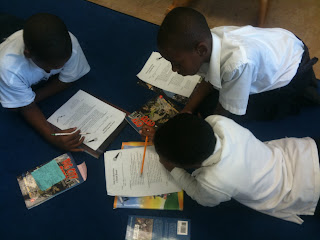
partner reading:
and book clubs:
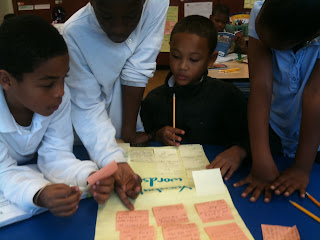
But the focus of Socratic Seminar has been more about getting students to talk directly to each other during whole class discussions. What does this entail? Well number one is that the actually LISTEN to what the speaker is saying. A much more difficult feat than it would seem. To help them do this, I....
-had them sit in a circle on the rug so that everyone can see everyone else
-created this chart with stems to help them respond to the speaker (in red) and push the speaker's thinking further (in blue):
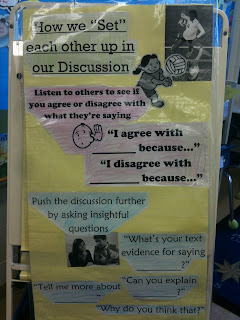
-used Classdojo.com (suggested by Ms. Willis) to track and incentivize use of the stems in our discussion
And it worked! Who knew, all I had to do was get out of the way and my students love talking to each other!?
One modification we had to make was that everyone begins seminar standing up in the circle and when they make a comment, they sit down. This helps us see who has spoken and who still needs to speak. It has helped all students feel like they have an opportunity to have their voices heard because everyone is motivated to call on people who have yet to speak so that by the end of seminar everyone is seated and we earn a group reward.
The best part of this (other than really interesting, far-reaching, and well-rounded and well-considered conversation about books we're reading as a class) is the carry-over it has with book club discussions. Before, book club discussions had a pschizophrenic aspect with everyone so eager to say something, that no one listened to each other, followed up on someone else's point, or anything like that. Since we started doing Socratic Seminar, students use the stems, and because they want to use the stems, they have to actually listen to their peers and build on their peers' thoughts or push their peers' thoughts further. Watch in the video how even though they need me to jump in occasionally to redirect the conversation, they are having intellectual arguments with each other! They're disagreeing, giving their reasons, going back to the text for evidence. They're building an intellectual identity. It's fun to be a nerd and argue!

partner reading:

and book clubs:

But the focus of Socratic Seminar has been more about getting students to talk directly to each other during whole class discussions. What does this entail? Well number one is that the actually LISTEN to what the speaker is saying. A much more difficult feat than it would seem. To help them do this, I....
-had them sit in a circle on the rug so that everyone can see everyone else
-created this chart with stems to help them respond to the speaker (in red) and push the speaker's thinking further (in blue):

-used Classdojo.com (suggested by Ms. Willis) to track and incentivize use of the stems in our discussion
And it worked! Who knew, all I had to do was get out of the way and my students love talking to each other!?
One modification we had to make was that everyone begins seminar standing up in the circle and when they make a comment, they sit down. This helps us see who has spoken and who still needs to speak. It has helped all students feel like they have an opportunity to have their voices heard because everyone is motivated to call on people who have yet to speak so that by the end of seminar everyone is seated and we earn a group reward.
The best part of this (other than really interesting, far-reaching, and well-rounded and well-considered conversation about books we're reading as a class) is the carry-over it has with book club discussions. Before, book club discussions had a pschizophrenic aspect with everyone so eager to say something, that no one listened to each other, followed up on someone else's point, or anything like that. Since we started doing Socratic Seminar, students use the stems, and because they want to use the stems, they have to actually listen to their peers and build on their peers' thoughts or push their peers' thoughts further. Watch in the video how even though they need me to jump in occasionally to redirect the conversation, they are having intellectual arguments with each other! They're disagreeing, giving their reasons, going back to the text for evidence. They're building an intellectual identity. It's fun to be a nerd and argue!
Donte's Looking Up Words!

I don't know why this student is so fascinating. I think he has such an interesting combination of curiosity, spaciness, and earnestness. During whole group lessons he's often spacing out to my enormous frustration, and during independent reading he's not always understanding 100% of what he's reading, or applying the strategy I taught perfectly. But he attempts everything at his pace with an innocence and independence that's truly refreshing.
Sunday, November 20, 2011
Thoughts about Selecting Students
5/6/7th graders (keeping in mind they need to be leaders socially, intellectually, and perhaps artistically. these need to be kids who will do most of the helping, rather than need to be helped):
Davion J (great artist, good reader, quiet, could be a good mentor for Donte, but is he forceful enough to keep him focused?)
Cortez (exuberant reader, very polite, I want to include him because I think he needs something like this right now)
Jamar (very high performing reader, excellent artist, can be a bit snobby so I wonder if he'll lose interest with easier graphic novels)
Tyree (good reader, amazing character, I'd love to have him but he's already very committed to dance afterschool)
Jawan (good reader, amazing character, I'd love to have him but he's already very committed to basketball afterschool)
At Risk 5th Graders (who could improve their reading through this program)
Japrice (loved reading Diary of a Wimpy Kid last year and making his own books, he'd LOVE this program)
Korian (very sweet, very energetic, still struggles with reading, doesn't seem to like it, I wonder if he'd be focused enough for this program)
4th Graders:
Tyshaun
Rashad (both of these guys would love it)
Alex (recommended Lunch Lady and Cyborg Substitute to me! would be a great mentor, can't stop talking about books)
Olajuwon (hangs out with me after school anyways, very smart, loves reading, would be a good mentor)
Josh (all around good student, wonderful personality, could use a push like this program)
Adonis (ditto, always with me afterschool anyways)
Deavion (needs this program, this program was conceived with him in mind)
Donte (ditto)
Jaymon (ditto, afterschool availability is a question mark)
Brandon (one of the brightest students, could use the push, always with me afterschool anyways)
Zeke (ditto)
Jaquez and David (from Ms. Willis' class, both really need this)
3rd Graders (per Ms. Garrison and Ms. Pendley's recommendation, I'm thinking of taking around 5 total)
That makes the total 25, which is way more than I was thinking. I think at least 5 won't show/be able to do it, which leaves me with 20. I think, although this group is on the bigger side, I'll be able to focus in on a few students for case studies, more qualitative data (I'm thinking Donte and Deavion for sure).
Next steps for this week:
-finalize which students I'll be inviting, send home parent survey + program brochure next monday
-finalize which graphic novels I'll be ordering for the program
-clarify the writing portion of the program, what templates will be used, how will i help them artistically - ask Ms. Morsher for help?
Davion J (great artist, good reader, quiet, could be a good mentor for Donte, but is he forceful enough to keep him focused?)
Cortez (exuberant reader, very polite, I want to include him because I think he needs something like this right now)
Jamar (very high performing reader, excellent artist, can be a bit snobby so I wonder if he'll lose interest with easier graphic novels)
Tyree (good reader, amazing character, I'd love to have him but he's already very committed to dance afterschool)
Jawan (good reader, amazing character, I'd love to have him but he's already very committed to basketball afterschool)
At Risk 5th Graders (who could improve their reading through this program)
Japrice (loved reading Diary of a Wimpy Kid last year and making his own books, he'd LOVE this program)
Korian (very sweet, very energetic, still struggles with reading, doesn't seem to like it, I wonder if he'd be focused enough for this program)
4th Graders:
Tyshaun
Rashad (both of these guys would love it)
Alex (recommended Lunch Lady and Cyborg Substitute to me! would be a great mentor, can't stop talking about books)
Olajuwon (hangs out with me after school anyways, very smart, loves reading, would be a good mentor)
Josh (all around good student, wonderful personality, could use a push like this program)
Adonis (ditto, always with me afterschool anyways)
Deavion (needs this program, this program was conceived with him in mind)
Donte (ditto)
Jaymon (ditto, afterschool availability is a question mark)
Brandon (one of the brightest students, could use the push, always with me afterschool anyways)
Zeke (ditto)
Jaquez and David (from Ms. Willis' class, both really need this)
3rd Graders (per Ms. Garrison and Ms. Pendley's recommendation, I'm thinking of taking around 5 total)
That makes the total 25, which is way more than I was thinking. I think at least 5 won't show/be able to do it, which leaves me with 20. I think, although this group is on the bigger side, I'll be able to focus in on a few students for case studies, more qualitative data (I'm thinking Donte and Deavion for sure).
Next steps for this week:
-finalize which students I'll be inviting, send home parent survey + program brochure next monday
-finalize which graphic novels I'll be ordering for the program
-clarify the writing portion of the program, what templates will be used, how will i help them artistically - ask Ms. Morsher for help?
Lunch Lady and the Cyborg Substitute

Ok, just finished Lunch Lady and the Cyborg Substitute by Jarrett Krosoczka. It had some very funny moments, great "spy gadgets" disguised as lunch lady equipment, including "chicken nugget bombs" and a "spatu-copter". It also developed consistent character traits. Of the 3 kids who suspect that the lunch lady has a secret life, one is a geek/wimp, another has low self-confidence, and the third is a "tough girl". There's the typical bully who is used to show the progress the geek/wimp has made over the course of the story. There's also 2 other plot lines (the kids are simply following the lunch lady). The lunch lady and her side kick "Betty" (kind of functions like Albert from Batman) are following a suspicious new substitute named Mr. Pasteur, who is part of a master plan by the science teacher to.... (I won't give it away). I think this would be a great story for the 4th graders in my guided reading group to read. They'd be able to follow the multiple plot lines, get the inside jokes/winks, and tackle the slightly difficult vocabulary. I'm not sure about this book for 3rd graders...might be too hard. Amazon does say it's grade 2 and up. The best part about it is that there are tons of books in the series.
graphic novel research
Interesting article about the pros of graphic novels:
http://www.libraryjournal.com/article/CA6312463.html by Allyson Lyga (School Library Journal 3/1/2006)
One of the most interesting ideas I got from it is creating a lesson around asking students to create captions/dialogue bubbles for pages that have no words. This is a great way to teach and assess comprehension and inferring.
The author also validated my observation of how it was easier for kids to read with expression because they can see the facial expressions of the characters! She adds that the pictures help students construct meaning. "Bryonna explained that when she looked at the pictures she thought about the words the characters were saying and she visualized the words in her head. Then, when she read the story to her sister, she created the dialogue and story based on the pictures."
I have always loved the idea of having students create their own graphic novels, and Lyga says that she did this as well, but I'll have to look elsewhere for resources/ specific instructions on how to teach this. Lyga does note that such an endeavor takes teamwork among the students (which I LOVE as a component of my afterschool program- perhaps splitting them up into teams of 4). I think eventually getting to the point where half the program involves reading, and then the other half of our time, they take techniques they learned in the reading and apply them into their own graphic novels. Perhaps they're even using many of the same characters from the graphic novel so they're transferring character traits, common settings; making inferences about possible actions their characters might take in the future, etc. The tricky thing about this is the artwork. It's a serious component with all the paneling, illustrations, etc. that I just don't have high knowledge about. Perhaps I need to partner with our wonderful art teacher?
Her book recs:
-Tintin Could be a little challenging for this age group, but enticing because there's a movie coming out as well (I know, I'm a movie geek!)
-Pinky and Stinky A story about 2 astronaut pigs? with a theme around pursuing your dreams? how awesome! i must read this book!
-The Day I Swapped My Dad for Two Goldfish It's by Neil Gaiman, so that's a big plus. I love the Sandman! (which we will not be reading!)
-Bumperboy Loses His Marbles! Sounds like an easier, simpler read, good for the 3rd graders in the program.
-Owly Volume 1: The Way Home & The Bittersweet Summer Almost completely wordless. I'm curious...
-Monkey vs. Robot Ecological theme? Hmm...
-Creating the X-Men: How Comic Books Come to Life A potentially terrific resource for teaching kids how to create a graphic novel, hopefully they give you step by step instructions.
Okay, all these graphic novels have got me excited! Time to research and read!
http://www.libraryjournal.com/article/CA6312463.html by Allyson Lyga (School Library Journal 3/1/2006)
One of the most interesting ideas I got from it is creating a lesson around asking students to create captions/dialogue bubbles for pages that have no words. This is a great way to teach and assess comprehension and inferring.
The author also validated my observation of how it was easier for kids to read with expression because they can see the facial expressions of the characters! She adds that the pictures help students construct meaning. "Bryonna explained that when she looked at the pictures she thought about the words the characters were saying and she visualized the words in her head. Then, when she read the story to her sister, she created the dialogue and story based on the pictures."
I have always loved the idea of having students create their own graphic novels, and Lyga says that she did this as well, but I'll have to look elsewhere for resources/ specific instructions on how to teach this. Lyga does note that such an endeavor takes teamwork among the students (which I LOVE as a component of my afterschool program- perhaps splitting them up into teams of 4). I think eventually getting to the point where half the program involves reading, and then the other half of our time, they take techniques they learned in the reading and apply them into their own graphic novels. Perhaps they're even using many of the same characters from the graphic novel so they're transferring character traits, common settings; making inferences about possible actions their characters might take in the future, etc. The tricky thing about this is the artwork. It's a serious component with all the paneling, illustrations, etc. that I just don't have high knowledge about. Perhaps I need to partner with our wonderful art teacher?
Her book recs:
-Tintin Could be a little challenging for this age group, but enticing because there's a movie coming out as well (I know, I'm a movie geek!)
-Pinky and Stinky A story about 2 astronaut pigs? with a theme around pursuing your dreams? how awesome! i must read this book!
-The Day I Swapped My Dad for Two Goldfish It's by Neil Gaiman, so that's a big plus. I love the Sandman! (which we will not be reading!)
-Bumperboy Loses His Marbles! Sounds like an easier, simpler read, good for the 3rd graders in the program.
-Owly Volume 1: The Way Home & The Bittersweet Summer Almost completely wordless. I'm curious...
-Monkey vs. Robot Ecological theme? Hmm...
-Creating the X-Men: How Comic Books Come to Life A potentially terrific resource for teaching kids how to create a graphic novel, hopefully they give you step by step instructions.
Okay, all these graphic novels have got me excited! Time to research and read!
Subscribe to:
Posts (Atom)